
Inside the Pyramid in Rome
From 20 to 22 September 2024, Tramite, a work created specifically for the burial chamber of the Pyramid of Cestius in Rome, was presented to the public. It comprised an installation by Fabrizio Crisafulli and an action by Melissa Lohman, developed thorough a working approach similar to that adopted for the Carrara event. Here too, the two works remained independent, yet were conceived in dialogue with one another.
The works were part of Piramide Contemporanea, a project organised by Sala 1, a contemporary art gallery in Rome directed by Mary Angela Schroth. It was carried out in collaboration with the Soprintendenza Speciale Archeologia, Belle Arti e Paesaggio of Rome, directed by Daniela Porro.
The Pyramid was built between 18 and 12 BC as the tomb of the Roman nobleman Gaius Cestius Epulo. It is a site with a two-thousand-year history and great historical and artistic significance. Between 2013 and 2015 it underwent a major restoration, overseen by the then Soprintendenza Speciale per il Patrimonio Archeologico of Rome and funded by the Japanese patron Yuzo Yagi. The burial chamber, a small rectangular room with a barrel-vaulted ceiling, has been altered several times over the centuries, but it still preserves its refined Pompeian-style decoration.
Piramide Contemporanea attracted considerable public interest. In particular, the project drew renewed attention to the monument itself, which is not readily accessible and remains off the city’s main tourist routes. For the first time, the Pyramid of Cestius became a venue for contemporary art conceived in response to the site and its distinctive features. In addition to the works by Crisafulli and Lohman, the initiative included an outdoor installation by the Japanese artist Uemon Ikeda. His work consisted of a web of red threads suspended above visitors’ heads, extending across the entire garden in front of the monument, on the side facing the Non-Catholic Cemetery.
Crisafulli and Lohman’s reflections on the project follow.
M.N.
Ruin and ‘Pure Present’
by Fabrizio Crisafulli
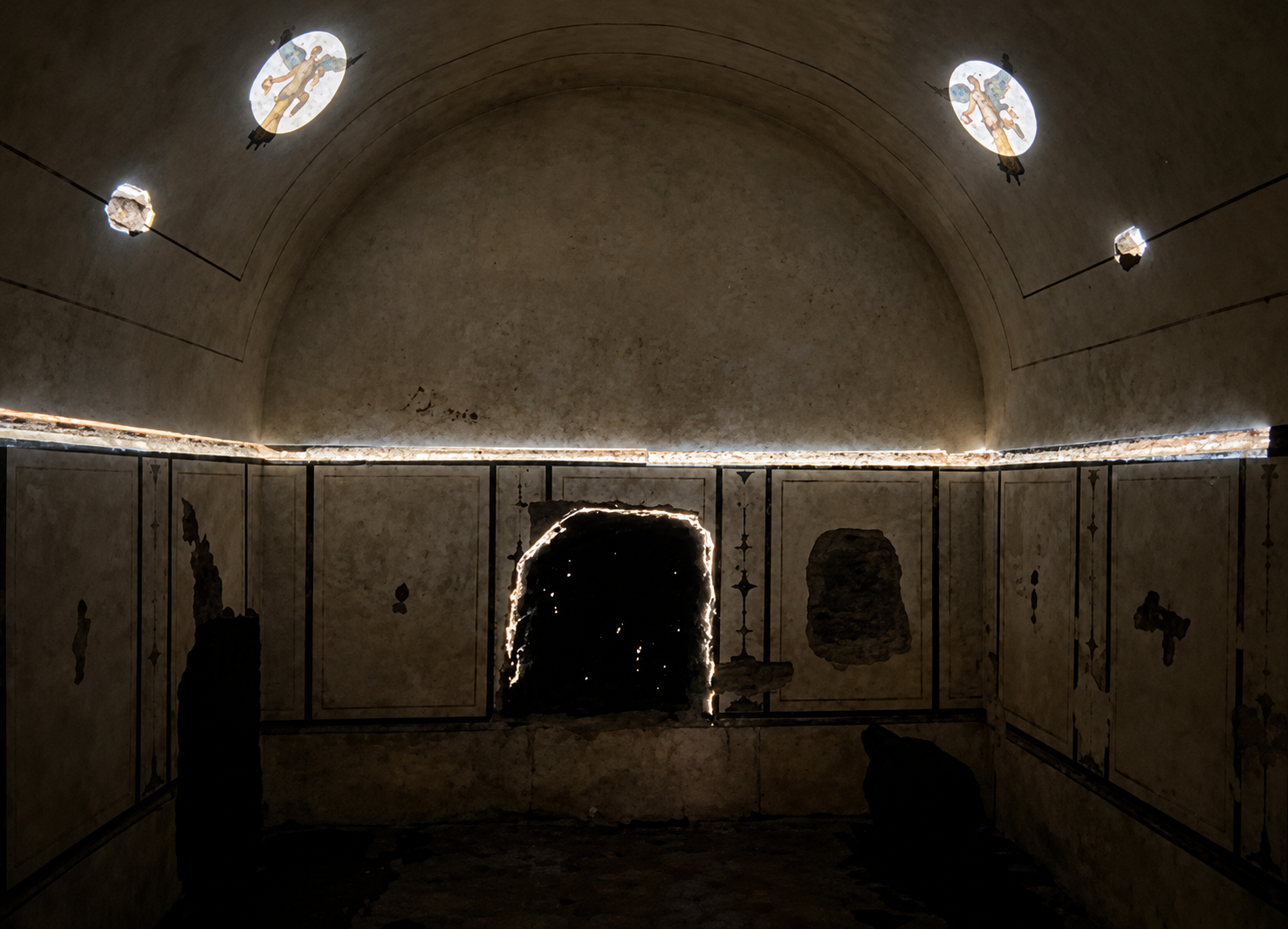
Tramite by Fabrizio Crisafulli and Melissa Lohman, burial chamber of the Pyramid of Cestius, Rome, 2024 (photo: Laura Perez)
The circumstances in which we worked at the Pyramid of Cestius in Rome were very different from those of other ‘theatre of place’ projects, including our work in Carrara. The situation in which we worked at the Pyramid of Cestius in Rome was very different from other contexts in which I have worked within the ‘theatre of place’ approach, including that of Carrara. There is, of course, an evident difference in the nature and function of the two sites. The first, the main hall of the Academy of Fine Arts in Carrara, is still in use and frequented by the academic community and others. The second, the burial chamber of the Pyramid, no longer serves its original function and has, at least in part, the character of a ruin.
Comparing the two situations may help us understand how, in this type of work, the place, with its particular characteristics, influences the way the work is structured. For anyone wishing to act within it, the most striking thing about the Pyramid’s burial chamber is how cramped it is. It measures 24 square metres and is located at ground level, in a central position within the Pyramid’s interior volume. It is reached through a narrow tunnel approximately 12 metres long. In its final stretch, the tunnel has a low ceiling, forcing anyone entering to stoop. These characteristics imposed precise constraints and shaped our choices regarding the configuration of the work and the organisation of audience access, to which I will return later.
The walls of the burial chamber are decorated in the Pompeian style with friezes and figures: priestesses and amphorae on the walls, and four winged Nikai on the vault. The surviving decorations have been restored. Set against them, as a counterpoint, are the marks of the break-ins and breaches made by ‘tomb robbers’ and by those who have used the space in various ways over the centuries. The signs and decorations relating to the deceased have been lost.
One factor that certainly influenced my approach was the sense of suspension I felt from my first visit to the chamber. I believe this was due not so much to reflections on its original function as a place of passage from life to death as, more generally, to the perception of time within it.
In Rovine e macerie (2004), Marc Augé argues that ancient works are essentially incomprehensible to people today. We perceive them very differently from the people who were their contemporaries, since we do not share their points of reference or their way of seeing. ‘It is this lack, this void, this gap between the vanished perception and the current perception that the work expresses today’ (p. 26, my translation). Referring to ruins, he goes on to argue that the perception of their ‘multiple pasts’ and their lost functionality places us in a time outside history, in a ‘pure present’. It seems to me that my state of mind had to do with this feeling, which Augé analyses so aptly.
The chamber’s ‘multiple pasts’ were reflected above all by the surviving wall paintings, by the alterations to the room, and by what was missing. What was missing was, for me, an immediate source of questions. When did the plundering take place? What had been there before, and what had been taken away? There are no definitive answers to these questions. Some things struck me in particular. One was the large breach in the centre of the back wall, where there were probably paintings and decorations relating to Gaius Cestius. Another was a pair of smaller holes, set fairly high on the side walls, evidently made to hold wooden beams supporting a mezzanine; the restoration has left them visible. They led my imagination back to the various uses to which the chamber had been put over the centuries it was left unguarded: as a shelter for shepherds or farmers, as a storeroom, and so on.
The prospect of Melissa performing in the chamber resonated with me. It echoed the kind of relationship between architecture and the human body inherent in the chamber’s original use. Albeit in a completely different way, we too were preparing to ‘inscribe’ a body within a monumental geometric volume: a rectangular solid contained within a pyramid.
The Pyramid of Cestius remains, in many respects, a place full of mystery. This is so even though it has acquired the status of a ‘monument’ and is an image of considerable importance in the urban fabric of the capital.
These elements, and probably others that are harder to express rationally, were the ground from which the installation emerged. Lucio Altarelli (2022) wrote that ruins ‘are not only witnesses of the past, but act as active presences, as objects of poetic reaction’ (p. 32, my translation). Augé (2004), for his part, writes: ‘It is up to art to save what is most precious in ruins and in the works of the past: a sense of time all the more stimulating and moving because it is irreducible to history, because it is consciousness of lack, expression of absence, pure desire’ (pp. 99–100, my translation). I find myself in agreement with these observations too.