
Place as Text, Body as Matter: A Conversation with Fabrizio Crisafulli and Melissa Lohman
edited by Mara Nerbano
back to contents
MARA NERBANO – Melissa, you’re from New York. Could you tell us a little about your background and training as an artist and performer?
MELISSA LOHMAN – I completed my Bachelor of Fine Arts degree in Sculpture at the School of Visual Arts in New York City in 2000. Rather than show my work in exhibition spaces and galleries after graduation, I experimented with music, acting, and performance. I became increasingly interested in using the body in the creative act. Consequently, I began taking various dance classes. As a young girl, I was passionate about dance. Despite having had no training for years, I immediately felt at ease. In New York, I could study any style of dance at any level. I studied classical ballet, contemporary dance, jazz, and Afro-Haitian dance. In 2004, I took a butoh dance workshop with Minako Seki. There, I glimpsed a bridge between visual art and dance. That experience gave me a way of thinking about the body as material, without being constrained by pre-established formulas. In the years that followed, I studied butoh with several Japanese masters, especially at Leimay, Cave Organization Inc. (then CAVE Art Space) in Brooklyn, NYC. Around the same time, I discovered Noguchi Taiso, Michizo Noguchi’s method, which includes exercises used by many butoh dancers and companies. This method strongly informs my work. I met my Noguchi teacher, Mari Osanai, in 2007. My improvisational work with various musicians, especially jazz musicians, gave me fundamental training in listening.
MN – What was your experience like when you arrived in Italy?
ML – I first came to Italy as a child in 1986, and lived in Rome until 1994, when I graduated from Marymount International School. I returned to Italy in 2010. I wanted to work here with one of my butoh teachers and explore new projects in Europe, but ultimately I wasn’t able to meet him. In Rome, I met the butoh dance company LIOS, which organised an annual butoh festival at the Teatro Furio Camillo, where they invited me to perform a solo in 2011. I developed a closer relationship with a member of the company, Flavio Arcangeli, with whom I still live and collaborate. Around the same time, I began an ongoing collaboration with the director, poet, and actor Marcello Sambati. I have recently also returned to the visual arts. A collaboration with the artist Giuseppe Tabacco led to a solo exhibition at the Museo delle Mura in Rome in 2021. The curator Antonello Tolve has since included my work in various group exhibitions in Italy and Romania. In 2016, I met Alberto D’Amico, who invited me to create several performances and visual works at his exhibition space, Studio Campo Boario, in Rome.
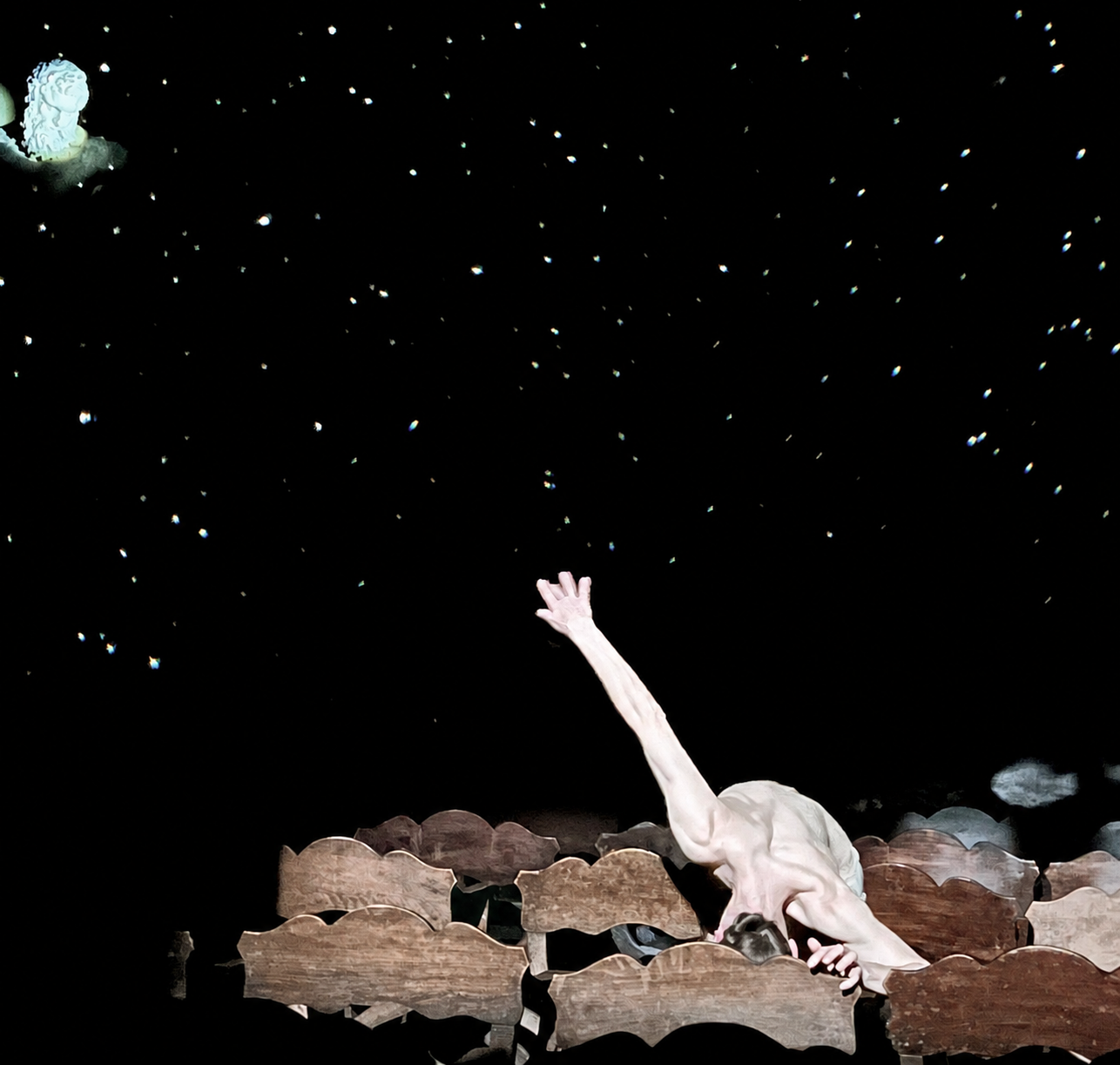
Melissa Lohman in Transiti, 2022 (photo: Italo Grassi)
MN – Fabrizio, how did you meet Melissa?
FABRIZIO CRISAFULLI – We met in 2018 on the occasion of Abitanti, a residency project I had been asked to lead at MACRO museum in Rome, in which I involved several other artists. Melissa was taking part, together with Flavio Arcangeli, in a performance by the sculptor Federica Luzzi. The following year, at Federica’s invitation, Melissa created an action of her own as part of Proiectum, an installation I made together with Federica at the Biblioteca Vallicelliana in Rome.
Melissa and I then worked together for a while in Naoya Takahara’s studio in Rome, along with Federica and Naoya himself, seeking, through the actions we created, a shared poetic dimension, without any intention of producing a finished work. Then, one day, at Studio Campo Boario in Rome, Melissa showed me her performance Monster Me, an extraordinary work I had previously seen on video. Her attentiveness and generosity towards me—on that occasion I was her sole, privileged spectator—struck me and brought me much closer to her.
In 2022, after the pandemic, I invited Melissa to take part in Bagliori, an installation I created at the ‘beach of the huts’ in the Maremma Regional Park, Tuscany. It consisted of a path a few hundred meters long, along which I placed large colored geometric shapes on the spontaneous structures that had been gradually built by local people from tree trunks deposited on the shore by the sea. Within that context, Melissa created a short action for the opening evening.
On all these occasions, I realised that Melissa develops a piece in much the same way as I work on a theatrical performance or an installation—a way of working closely tied to listening. After a period of preparation, she proceeds step by step, with openness, through a poetic process of successive associations and the gradual production of meaning.
ML – I was pleasantly surprised that, while Fabrizio was building Bagliori, I was left free for a couple of days on the beach to decide how to intervene. I had to find a way to inhabit the place and the installation. Fabrizio’s trust in allowing me to find my own presence within his work and on the beach was fundamental. It was a departure from his usual way of working. In our collaboration, Fabrizio puts aside his usual role as director and opens himself to the exchange between the two of us. Another fundamental thing we discovered we had in common was a sense of irony and playfulness in our work.
MN – How did you relate to each other while working on Transiti, the installation-performance you created at the Carrara Academy?
ML – Fabrizio involved me in the process from the beginning, even in the choice of location. Our interaction was fluid and organic. As soon as we entered the space, we began to listen and reflect, without speaking too much. It almost seemed as if the work already existed and our task was to make it manifest. Perhaps because, in a place with such strong elements as the Academy’s main hall, it was enough to open a dialogue with what was present, rather than adding too many elements. In relating to a place, I consider myself one of the elements of the work, rather than its central element. The form of the body, whatever it does, is in relation to light and shadow, to architectural elements, to the objects and other bodies present. I want to inhabit the place and be observed, rather than show something to an audience.
FC – Transiti was the fruit of a collaboration between two artists, in which each of us kept our own direction in mind while, at the same time, taking into account what the other was saying and doing, and drawing further motivations from this exchanges. We moved in the same direction, not only because of our affinities in how we conceive of work in general. The direction emerged specifically through our being and acting in the space, through our exchanges and connections, from the moment we began working concretely. We worked with intense concentration and in silence, allowing precise—and, in certain respects, somewhat mysterious—conjunctions to emerge.
MN – How did the choices that shaped the piece come about?
FC – They emerged from the visit to the site and were gradually refined during the work there, as associations and motifs linked to the place grew richer. Several reasons came together around each of them. After visiting the Academy, we chose to work in the main hall. From the very beginning, we were drawn to the wooden chairs, which form a strong presence in the hall, partly because of their wavy backrests—which together form a kind of ‘sea’. It was immediately clear to us that the action would take place among those chairs, which, moreover, creak when you sit or move on them. When the space fills with people, those creaks become its underlying sound.
ML – Our first concrete initiative was to record the creaking sounds. Another important feature of the room is the large central Murano glass chandelier, which Fabrizio was immediately drawn to. It’s no coincidence that my action was placed in the center of the room, beneath the chandelier.
FC – Along the perimeter of the hall, there are classical statues. When Melissa began working among the chairs, I thought that the statues, which face towards the center of the space, were establishing a relationship with her. It almost seemed to me as if they were watching her. I decided to isolate their heads, their faces, with light, bringing them out of the darkness and illuminating them individually with very narrow beams of light. This made them stand out more clearly as a group. They became ‘planets’. Laura Perez, who was assisting me, said at one point that they were ‘seven, like the planets of classical astrology!’ I think it was during that phase of conjunctions, when the hall was slowly transforming into a ‘cosmos’, with its own characteristics, relationships, and alignments, that I came up with the idea of the starry sky. This idea had already begun to surface earlier, in connection with the decision to use the creaks of the chairs as sound material. I associated the dots of light from the stars with the ‘dots’ of sound produced by the creaks. I was intrigued by the tension that could be created between the stars and the earthly dimension of the creaks.
ML – The installation was developed in layers, and the phases of my work were informed by this progression. At first, I worked with my body in relation to the chairs. I spent time selecting the best chairs to use from the many there were, establishing a relationship with them that helped me understand how I should move. I would lower my body and then emerge, connecting with their shapes, their ability to support me, and with their creaking as I moved. I gradually defined my presence in the place. Each time I returned after a break, I found that the space had changed. It gradually became another place, increasingly dark and mysterious, with new elements, other details; a dreamlike yet strangely real place, without theatrical tricks or the insertion of external elements. I felt happy to work in the new place Fabrizio created from the existing one by amplifying it, inverting it, revealing it, opening a dimension outside of time. It was a dimension in which my perception was amplified. It was wonderful to move among the chairs beneath that starry sky, watched over by the sculptures, as though I were on an old boat or wandering through a forest. It created a tension and vitality in the work.
FC – As I moved forward with the work, I found new solutions in response to what Melissa was doing as well. If I had created the installation alone, without her presence, a different piece would have emerged. Going back to the starry sky, once it was in place, it brought the different elements together—including the chandelier—into a single vision. I asked the students, who were helping us with great enthusiasm, to make the small star-shaped openings in the light-filtering masks denser right where the chandelier was. That denser patch of ‘firmament’, reflected in the Murano glass, gave the chandelier a new presence—a more subdued one that still preserved the memory of its centrality, while stripping the object of its character as a piece of furniture. The other pole was, naturally, the site of Melissa’s action: the group of chairs at the center of the room, lit by a rectangle of light. It was, in a way, the planet Earth, which in its own way further motivated the choice of the stars.
MN – The motif of stars, incidentally, recurs often in your work.
FC – Yes, over the years it has come up on several occasions, each time with its own specific approach and meaning. Going back in time, I think of the starry sky in In cerca di frasi vere, the piece dedicated to Ingeborg Bachmann that Daria Deflorian and I created in 1993. The stars, in that case, moved slowly through the dark space and seemed to flicker. It was a ‘nervous’ firmament, while Daria, tense, delivered one of Bachmann’s Frankfurt Lectures.
The starry sky is a recurring figure in Bachmann’s poetic world, and it’s no coincidence that it also appeared in Acuta di conoscenza, amara di nostalgia, the performance that Daria and I dedicated to the Austrian writer that same year. It consisted of the many lightbulbs in the wall sconces and chandeliers, which I had fitted with dimmers, in the ‘hall of mirrors’ of the Teatro Flavio Vespasiano in Rieti, where the work was developed and took place. At a particular point in the performance, I would bring them down to their lowest intensity, turning them into small reddish points. Bachmann died after falling asleep at home with a lit cigarette that set fire to the scarf she was wearing. In the dark, the incandescent bulbs, kept at their lowest intensity, looked like lit cigarettes. In those cigarette-stars there was also the memory of the tragedy.
In the piece Le addormentate, from 1995, also created together with Daria Deflorian, the ‘starry sky’—or rather, what at certain moments could appear as such in relation to the overall conditions of the scene—was made up of about a hundred white bars of soap arranged on the back wall, slightly projecting outward. The idea came to me from the role of perfume in Yasunari Kawabata’s story The House of the Sleeping Beauties, to which the piece was dedicated.
In Lingua stellare, from 2000, a kind of electronic starry sky formed at the end of the performance above the spectators’ heads. These were little green chemical lights, like the ones fishermen use, mounted on the ends of telescopic poles that the performers, in the dark, gradually raised into that position. One might have thought they were flying cell phones gradually composing the firmament. During the performance, dedicated to Velimir Khlebnikov and his idea—anticipating the internet—of communication at a distance, we had asked the spectators, who had left their phone numbers at the entrance, to turn on their phones without answering, and at a certain point we called them one by one to create a kind of ringtone concert in the hall. That starry sky was the final reappearance of the same ‘vision’, in a different form.
In Numina, a nocturnal piece created that same year in the Etruscan necropolis of Cerveteri, I instead arranged for all the lights to go out when the audience arrived in a clearing, so that the real starry sky could emerge. It then began to envelop, ever more deeply, a part of the performance made up only of voices.
MN – Fabrizio, earlier you spoke of the emergence, in the course of creating Transiti, of mysterious conjunctions: could you clarify this concept further?
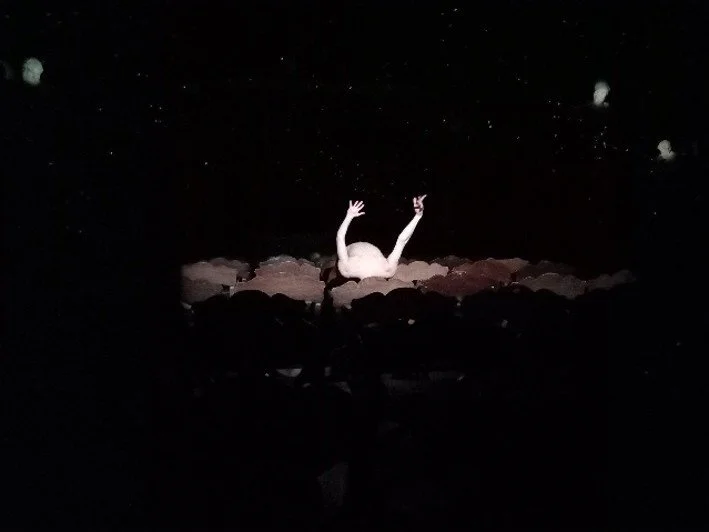
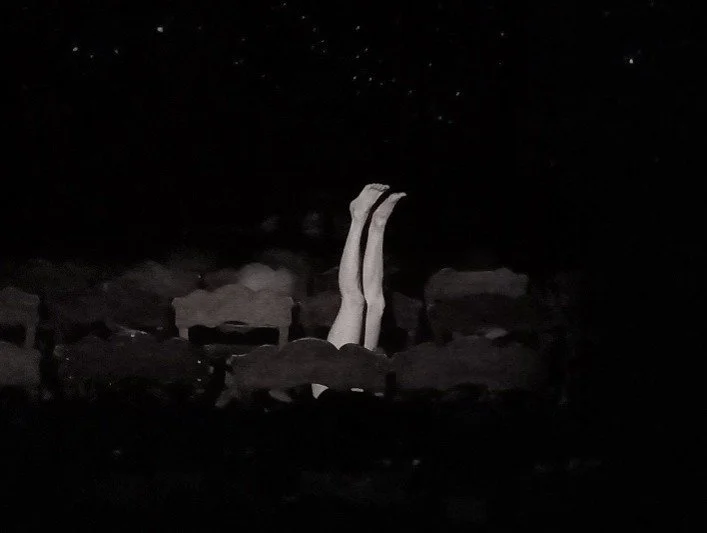
Transiti, 2022 (photo: Gatd)
FC – Let me give an example. During her performance, Melissa would emerge from the chairs, giving rise to a whole series of ‘apparitions’. Each one had its own motivation and meaning in that place and at that moment. They weren’t simulated or representational actions. With each emergence, her body opened up different possible associations—associations with animals or landscapes, for instance. At a certain point, when she came out with just her legs, rising vertically from below, I thought of Bosch’s triptych The Garden of Earthly Delights. Melissa surfaced from the chairs showing mostly her back, her shoulders, her arms, her legs, her feet. She rarely showed her head. Never her face. In this way she acted as a counterpart—and here I come to the ‘mysterious’ conjunctions—to the statues, of which, conversely, only the head and face were visible. We never actually talked about this inverse connection. Evidently, we both felt it was right. And, of course, it had other motivations too, like avoiding, in Melissa’s presence, any identification with a specific character.
ML – In my work, I often hide my face, leaving things more ambiguous and open, so as not to create identification. In Carrara, the statues' faces and the chairs, on the horizontal plane, were very strong elements that influenced me. Similarly, on the vertical plane, the chandelier had all but forced me to place my action at the center. These elements created a strong underlying structure which gave freedom to the relationship between Fabrizio and me. In the hall, the statues’ gazes were visible, not mine. Their illuminated faces observed me. My body tried to comprehend itself beneath those gazes, a being in constant transformation.
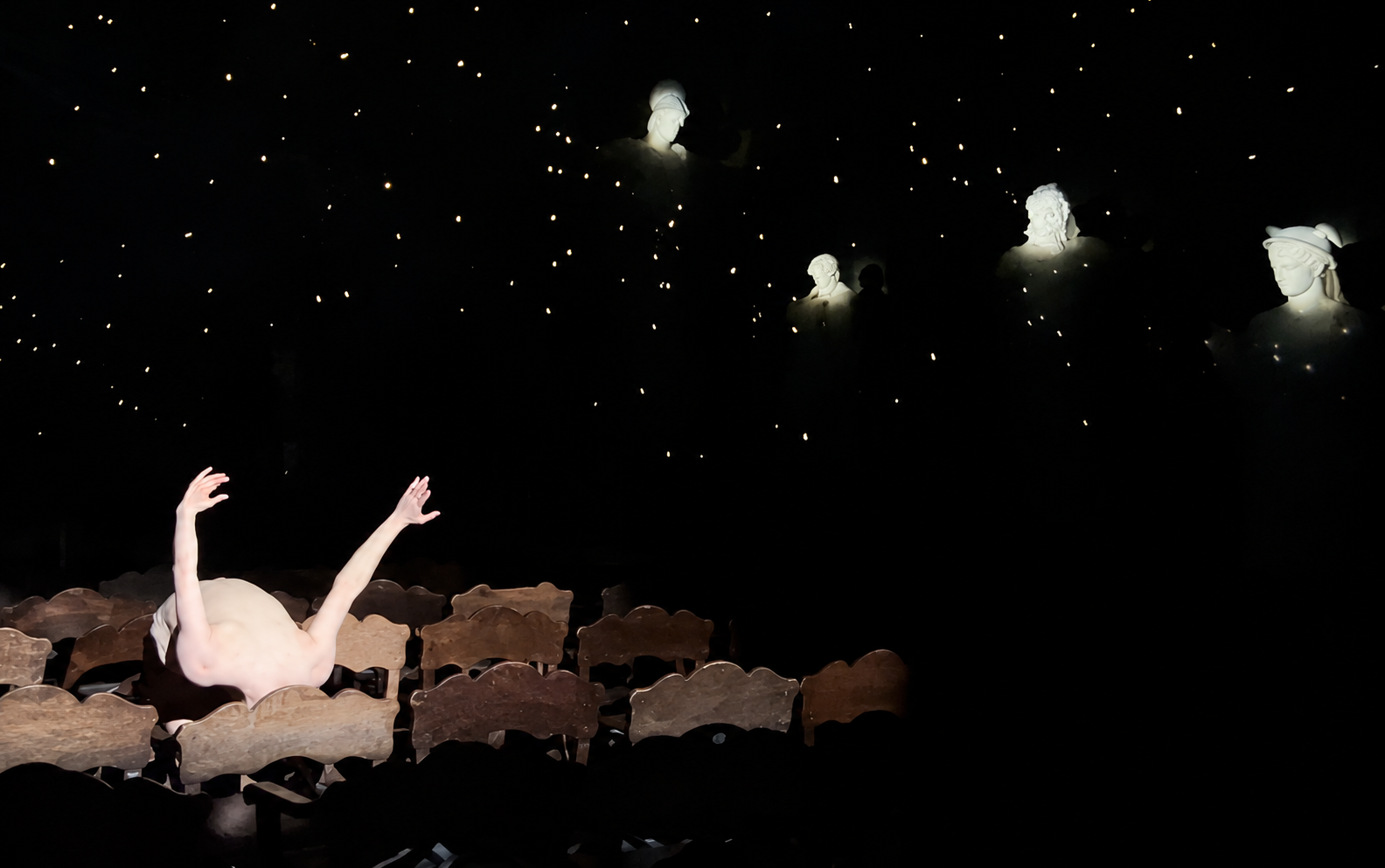
Transiti, 2022 (photo: Laura Perez)
FC – The plurality of meanings is another aspect that our ways of working have in common. Neither Melissa nor I intend to convey predefined meanings. It’s poetic work. We invite the spectator to enter into a circle of imagination and thought. In this approach, the task of whoever is on stage is not to interpret a character or represent facts, but to find their own ‘being’ within a given condition. Perhaps it’s a kind of work that should be analyzed in ethological terms, in terms of behavior—and understood above all in terms of the relationships it establishes. The subtle interplay between Melissa and me during the creative process made me think of what science calls ‘emergent behaviors’: those behaviors, studied in animals (such as the flocks of birds investigated by Italian Nobel laureate Giorgio Parisi) or in the field of cognitive science, that arise from the interaction of multiple individuals and cannot be understood based on individual behavior alone. They ‘emerge’, precisely, in relation. In the end, they produce an integrated outcome without any central decision having been made.
MN – This is a fascinating aspect. It has made me think, on other occasions, about the activation of a kind of ‘group mind’. How did this idea take shape for you?
FC – It has come to mind many times over the years. What comes to me now is the performance we created with the Abitare un luogo [Inhabiting a Place] workshop, which I held at MACRO in Rome in 2019. There too, we started from a precise environmental condition consisting of a room in the museum and the installation I had created there. I had taken what is a normal attitude in my theatrical work to an extreme—namely, treating the conditions external to the performer as decisive in the construction of actions. I was struck by the fact that all the participants sensed that the work had come together almost independently of individual intentions, as the outcome of an unconscious collective movement. In Transiti, of course, there were two of us, not a group—I wasn’t on stage, and Melissa was the author of the action. But our behaviors, the indirect relationships, the imponderable reasons, understandable only through our being in that place and within a precise ‘state of affairs’, made me think of this again.
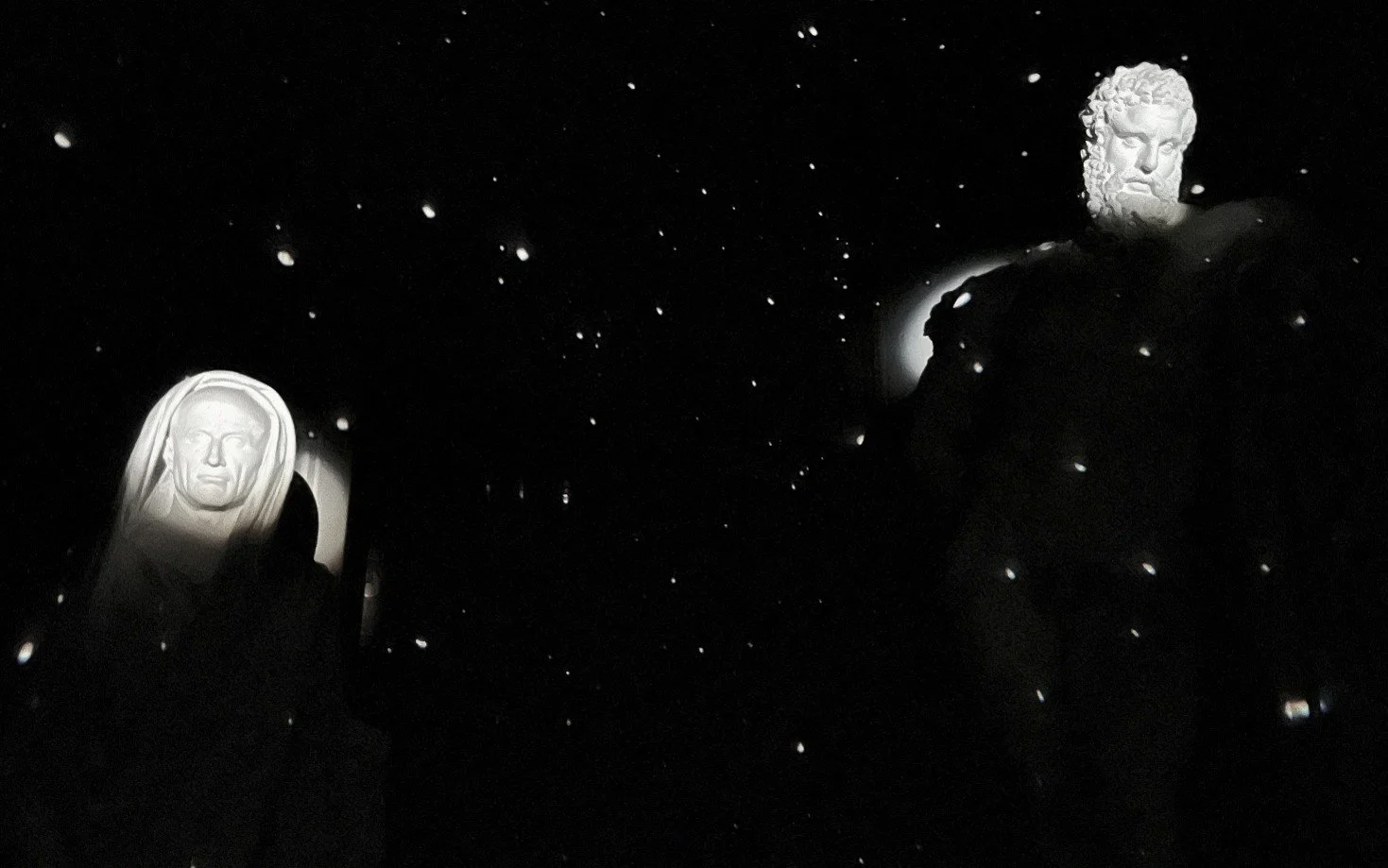
Transiti, 2022 (photo: Gatd)
MN – Melissa, do you agree with Fabrizio?
ML – Yes, absolutely. In situations like this, if at a certain point one performer is given the command to lead the group, everything collapses. This is very significant for what we’re talking about. The condition of flocks of birds intrigues me. There’s a balance in which everyone and no one is the leader, where it’s unclear who leads, who follows, who’s ahead and who’s behind. I once happened to participate in a dance workshop where the condition of flocks of birds was given as a model for finding a collective flow. The flow couldn’t occur because individual impulses, accelerations, and each performer’s ego prevailed, rather than listening. The basic conditions hadn’t been established; there was no underlying structure.
FC – In the case of flocks, there’s a specific context, specific circumstances, and specific needs. If these specificities are missing, there can be no ‘emergent behaviours’. That’s the point. I wasn’t there, but perhaps in that workshop these specificities were lacking. What’s more, the intentions, as you say, were explicit. And that may not have allowed things to develop in the right direction. Here, we are dealing not so much with intentions as with necessity. I believe that, for the kind of dynamic we’re talking about to emerge, a condition of necessity is essential. Necessity, in animals, is tied to survival. And perhaps in our case too, in a certain sense, given that we had to measure ourselves against—and had to ‘survive’ in relation to—the constraints imposed by the place, as well as the need to make the work function within the conditions it presents.
MN – So let’s go back to the theme of ‘place’ as a generative element of the performance: a central subject in your artistic research.
FC – The question of place is central—it’s an entity with its own memories, its own rules, and its own forces, which cannot be ignored. I recently saw a video of an actor who, in an outdoor performance, was standing on top of a well. It was useful for him to be in an elevated spot, so he’d placed himself up there, as if it were just a platform. But his action had nothing to do with the well and was in no way affected by the fact that he was there. Now, I think that, from the perspective we’re exploring here, you can’t use a well while completely ignoring what it is, what it evokes, and its force. That actor was literally ‘out of place’.
ML – Many years ago, I performed a solo at a festival in California. A small stage was available, but the backdrop wasn’t black. A large golden sun was painted on it. During rehearsals, I pointed this important detail out to my teacher. I remember him pausing at my observation. He probably thought I was overly concerned about it. For me, if the space where I’m performing isn’t empty, if there are objects or other elements, I can’t ignore them. The body is in relationship with its surroundings.
MN – Melissa, you also talk about a ‘conductive body’. Could you explain what you mean by that?
ML – The Conductive Body is the title I use for my workshops. To consider the body as conductive is a central aspect of my research. I inhabit my body. Its presence, which contains all of my experiences, alters the space in which it resides and transmits information before I even intervene. I can think of my body as mine and not only mine, and as an instrument of expression. Another thought I place alongside the concept of conductivity is that the body has a much longer memory than the individual who inhabits it. If I can calm my preconceived notions and opinions, I can allow my body to move and be moved by the impulses it receives and transmits, perhaps in ways I would not have expected or otherwise suppressed or modified. On a practical level, one can train oneself to be in a state of listening and readiness for the impulses that pass through the body. In this way, one can begin to notice the micro-movements, shifts and sounds within the body. In Noguchi Taiso and butoh dance, for example, the body is considered watery and separated from the outside world only by the porous membrane of the skin. The internal space is not clearly divided from the space around it. This allows the individual to receive impulses from all sides and also to transmit them.
MN – When, a moment ago, you spoke of the body as material, I understood that the body could constitute the raw material of the artwork, in a way analogous to what happens, for example, in other art forms with marble, clay, or paint. Now, however, it seems to me that you also consider the body, quite literally, as a substance endowed with specific properties—in particular, the capacity to be traversed by currents that are invisible but nonetheless real. Is that right?
ML – I often use my body as material, and consequently, I am also the work itself. A particular aspect of this dual role is that it requires me to return each time to a state of listening and observation, before acting and creating something new. It’s like working with the same block of clay over and over again, creating a work, then reforming it into a whole to begin again. But I am not an inert block of clay. Unlike other materials, such as marble or clay, the body is a living, mutable, and impermanent material. Being alive, it is truly a conductor and container of energy. One can choose how to direct these, as you said, ‘invisible currents’ of energy that flow through the body, to perform a simple gesture or a complex dance choreography.
MN – The other aspect I’d like you to clarify further concerns the memory of the body: are you referring to an ancestral unconscious of the species, or to something even more archaic, inherent in our being as biological organisms? Or perhaps to both?
ML – When I say the body has memory, from a non-scientific perspective, I mean it also has to do with biology. I am made up of approximately 37 trillion cells that must know what to do to keep me alive and moving. There must be some semblance of memory in them of how to behave and organise themselves, right? Then there is my individual experience, influenced by where I was born, the environment, the culture, my health, the DNA inherited from my ancestors who in turn inherited it from their ancestors, all the way back to the first single-celled organism... As I mentioned, in Michizo Noguchi’s method, the skin is considered a porous membrane that separates the body from the surrounding space, similar to how a very thin membrane separated the first aqueous organism from the water surrounding it. I think of how the body is composed of the same elements present in all living beings. It is rich material because it is alive, regardless of my personal opinions. Reflecting on these things, when I use it to make art, I try to suspend my prejudices and listen to it even on a cellular level. What emerges then is more complex. I allow new qualities to emerge in my actions when I give my body the freedom to express itself.
MN – To conclude, I’d like to return briefly to the performance you created in Carrara. An essential component of it was the sound score. How did you work on sound and with sound?
FC – In a certain sense, it was the place itself that ‘generated’ the sound. As I mentioned, the creaking of the chairs was the first sound element we worked on: an element that belongs to the life of the room, and that took on new life and new meaning through Melissa’s action and within the context of the installation. The recorded creaks came to form the basis of the sound score, to which we added the sounds of crystal; explosions, suggested by the presence of the marble quarries in the area, visible from the academy itself; and low voices that surfaced now and then, barely distinguishable.
Processing these sounds did not produce a continuous layer of sound or a mere backdrop. At times, the recorded creaks would break off, allowing the real creaks produced by Melissa’s action to emerge. The blasts served almost as markers, creating interruptions and new beginnings. The crystal sounds were associated with the presence of the chandelier; the voices could be mistaken for the low murmurs or brief exchanges among the spectators in the semi-darkness. There was an interplay between place, installation, action, and audience. This is in line with the work I have been doing for many years in specific places with Andreino Salvadori, who also handled the sound for Transiti.
ML – I’ve spoken of my body in relation to the visible elements of the space, but there are always audible elements within it as well. These are equally fundamental aspects that I must take into account. I found our choice to amplify the noises produced by the chairs, usually annoying during conferences and lectures, not only suggestive but also ironic. Andreino’s looped sound composition gave me a sense of the space’s temporality.