
The Sky beneath the Main Hall: Crisafulli and Lohman’s Transiti at Carrara
by Mara Nerbano
back to the index
The hall is immersed in darkness. One reaches it by crossing an atrium flooded with natural light from a large three-light mullioned window. Upon entering, before the eye has time to adjust, one can make out only the silhouettes of the other spectators, standing before an expanse of Savonarola chairs arranged in neat rows and seen from behind. Above, a vault of pinpoint lights uncannily resembling a starry sky: sparse at the edges and denser towards the centre, where they cluster around the large Murano glass chandelier, barely discernible in the middle of the hall.
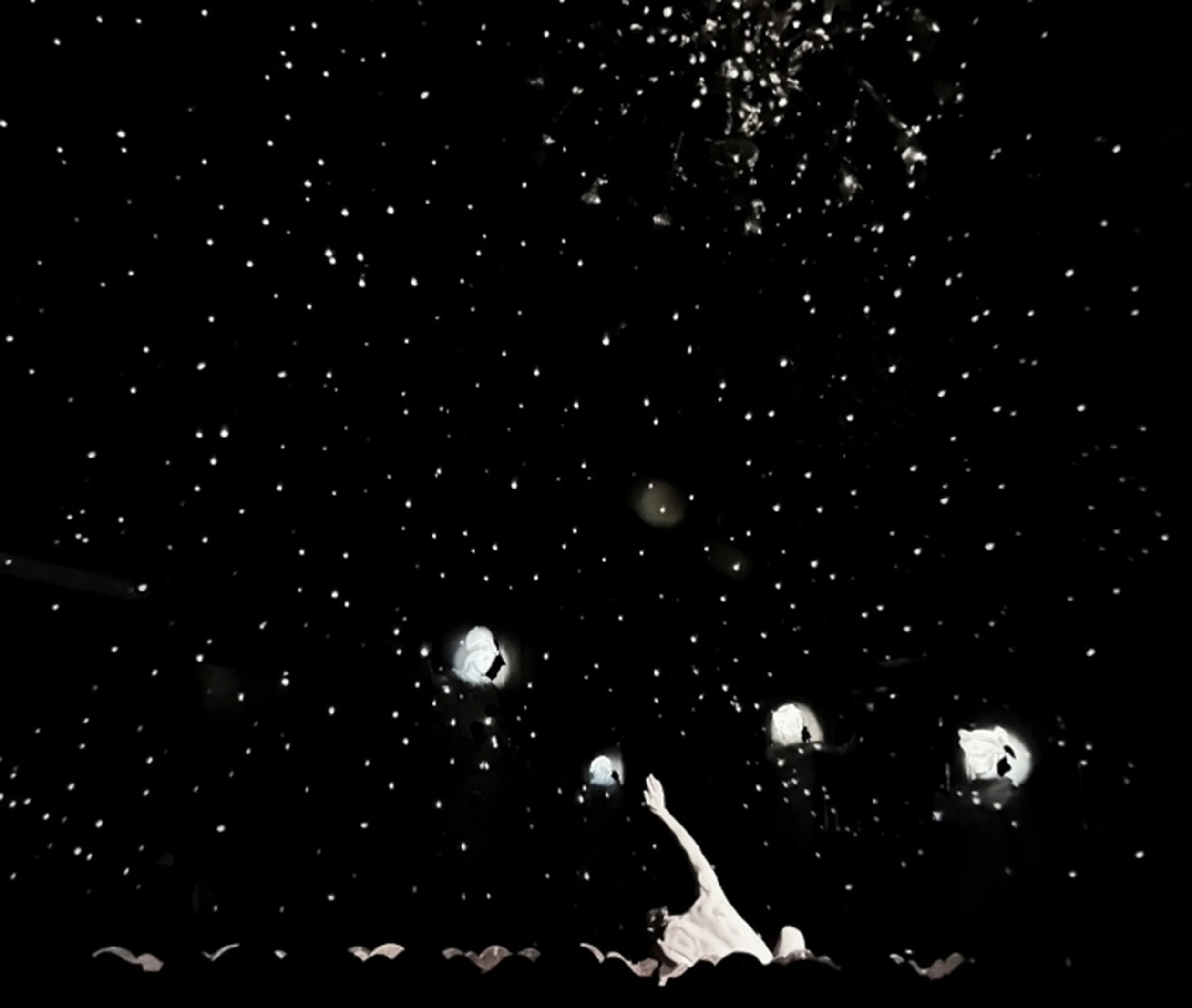
Transiti by Fabrizio Crisafulli and Melissa Lohman, Academy of Fine Arts, Carrara, 2022 (photo: Laura Perez)
Below, along the same axis, light carves out a rectangular area crossed by the undulating lines of four rows of chairs. Within it, a slight, pale figure, almost sculptural, slowly rises and sinks among these waves. One after another, a hand, an arm, the shoulders, the torso, the legs, the feet emerge: the body is transfigured into almost abstract forms, in a continuous process of metamorphosis, carried by a sonic flow of creaks, tinkling sounds, barely audible voices, explosions and silences. Along the perimeter, picked out by circular pools of light, the suspended, majestic faces of seven classical statues seem to float, watching over the action.
The performance unfolds over two hours as a continuously evolving creation, existing in symbiosis with its surroundings, the objects within the space and the intangible energies that permeate it. At the centre of the scene stands Melissa Lohman, embodying a ‘living sculpture’ whose face remains unseen. The luminous installation is created by Fabrizio Crisafulli.
A director, visual artist, researcher and educator whose theatrical career spans more than three decades, Fabrizio Crisafulli is one of the leading figures in Italian experimental theatre. Born in Catania in 1948, he received his theatrical training within the cantine scene – the network of small experimental theatre venues that flourished in Rome during the 1960s and 1970s. He began his professional career as an architect and urban planner before devoting himself to theatre, later teaching stage design and theatrical techniques at Italian academies of fine arts.
Since the early 1990s, he has pursued an ongoing research project centred on two main strands: ‘theatre of place’, conceived as a working approach that takes the ‘place’ itself as the matrix of the theatrical event, and ‘active light’, understood as the use of light as a primary and integral element in structuring the theatrical work[1].
A performer, choreographer, dancer and visual artist, Melissa Lohman works between Rome and New York. Born in New York in 1976, she began performing at a young age and made her debut in the mid-1990s, after earning a degree in fine arts and undertaking extensive training in dance. Her research and creative practice, informed above all by Butoh and Noguchi Taiso, focus primarily on the body as the material of the artwork[2].
The two artists, whose paths had already crossed in several collaborations between 2018 and 2022, presented their first co-authored work at the Carrara Academy. It was the outcome of a creative process that brought them into a rare state of attunement, as I had the opportunity to observe at first hand[3].
They devoted several months to preparing the work, from the initial design stage to its public presentation. It all began when I proposed that Fabrizio Crisafulli lead an educational workshop aimed at creating a ‘theatre of place’ intervention in the Academy’s historic building. He suggested involving Melissa Lohman in the project, sensing that her particular approach to the work would enable her to engage effectively with the environment and with the statuary collections that dominate the institution’s principal teaching and ceremonial spaces.
It is above all to the practice of sculpture that the Carrara Academy owes its international fame and prestige. Founded in 1769 by Duchess Maria Teresa Cybo in a region whose economy has traditionally relied on marble quarrying, the institution has gone through successive periods of decline and revival over the course of its long history. Two turning points stand out as particularly significant. The first came during the Napoleonic era, when the institution was reformed by Grand Duchess Elisa Bonaparte Baciocchi, who, in 1810, granted it the prestigious Palazzo Ducale as its new home, in the heart of the historic centre. The second occurred during the Fascist era. Adolfo Angeli, a local politician and president of the Academy from 1924 to 1936, promoted a complete renovation of the building that still houses the institution today, together with a museum-style arrangement of its substantial holdings. These comprised archaeological finds, casts of ancient works, collections of Neoclassical plaster casts, and exercises and works by the school’s masters and students. This arrangement established the Academy not only as an educational institution but also as an exhibition venue and a point of reference for local artistic culture[1].
In designing an intervention within a place so densely stratified with memories and material traces, the precise choice of location was a crucial preliminary step. From the earliest stages of discussion, following an analysis of the photographic documentation, Crisafulli’s attention had focused primarily on the Academy’s main hall. This choice was confirmed during the artists’ visit to the building.
The main hall is a spacious room measuring approximately 17 metres in length and 14 metres in width, and extending over two storeys in height. Its current configuration dates back to the restoration campaign undertaken between the 1920s and 1930s. At that time the institute’s president, Adolfo Angeli, sought to transform it into the building’s most prestigious and representative space: one that could serve at once as a teaching room, ceremonial hall and museum environment. On that occasion, under the direction of the architect Ugo Prayer Galletti, an elaborate decorative scheme and Neo-Renaissance furnishings were designed to accommodate the hall’s multiple functions, in keeping with the stylistic language adopted throughout the interiors of the piano nobile. The ensemble included a polychrome coffered ceiling enriched with grotesque friezes, a floor in white marble and bardiglio, and refined mahogany furnishings, among them an imposing armchair, carved benches and Savonarola chairs. The ensemble was crowned by a majestic Murano glass chandelier, standing 3.30 metres high and 1.90 metres in diameter.
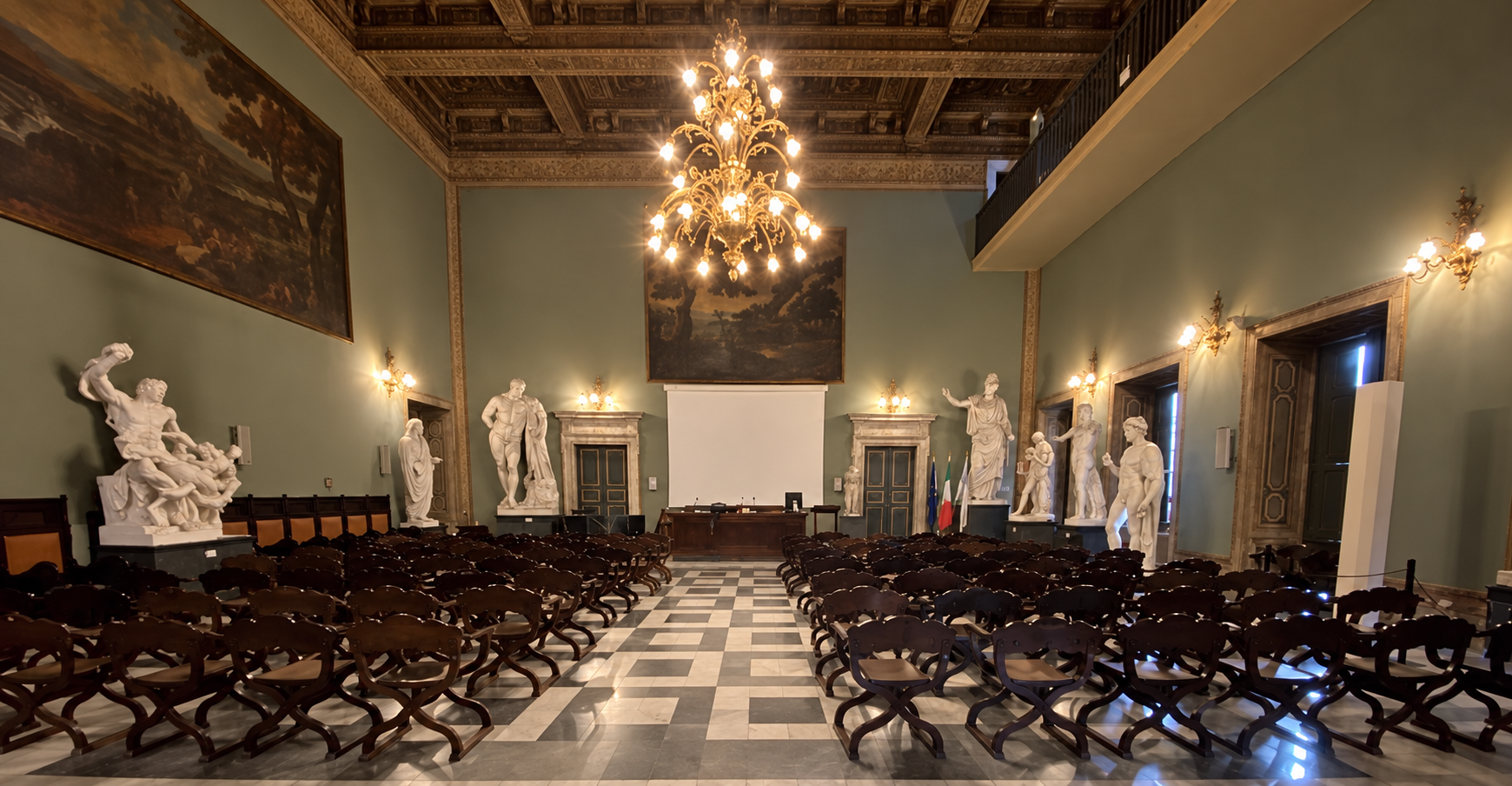
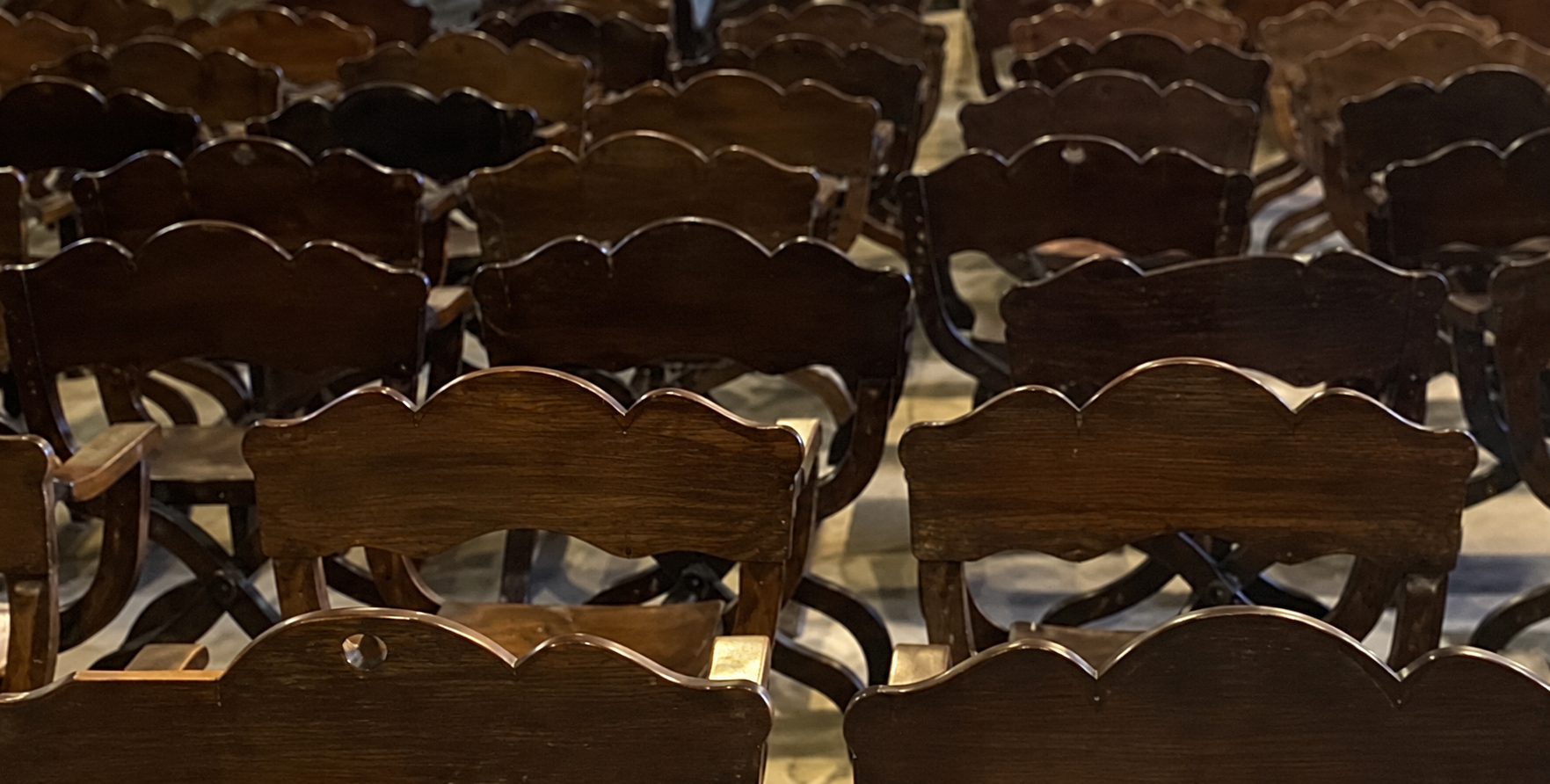
The main hall of the Academy of Fine Arts, Carrara
Along the perimeter of the hall stood plaster casts of some of the most celebrated sculptures of antiquity, serving as models from which generations of students had learnt and practised drawing. Eleven casts were included in the original arrangement, while fourteen are present today.
Once the decision had been made to work within the main hall, preparations for the performance moved forward relatively quickly. The day after the initial site visit, Crisafulli and Lohman expressed the wish to spend several hours in the space. Wishing to make my presence as unobtrusive as possible, I left them to engage with the room on their own, as they observed and explored it with an almost meditative attentiveness. They remained mostly silent, occasionally exchanging brief impressions in hushed voices. I saw them again a few weeks later, when the actual production phase began, unfolding as an intensive period of just three days.
With the assistance of the students taking part in the workshop, the hall was completely darkened with heavy black curtains, preventing any external light from entering through the windows, the upper gallery or the doors leading into the room. All entrances were kept closed, with the exception of the first door on the right upon entering the piano nobile from the monumental staircase. This doorway, carefully screened, was left open to provide access for spectators.
Interventions on the furnishings were deliberately kept to a minimum. The two artists chose to avoid any alteration or transformation of the existing arrangement, limiting themselves to a few small but essential adjustments to the positioning of the chairs. The final row was moved further back in order to define the boundary between performance area and audience, thereby establishing a frontal viewing position. The remaining rows were simply brought closer together and aligned side by side, removing the central aisle and creating a compact rectangular configuration at the centre of the hall. It was within this newly defined space, directly beneath the chandelier, that Lohman would situate her performance.
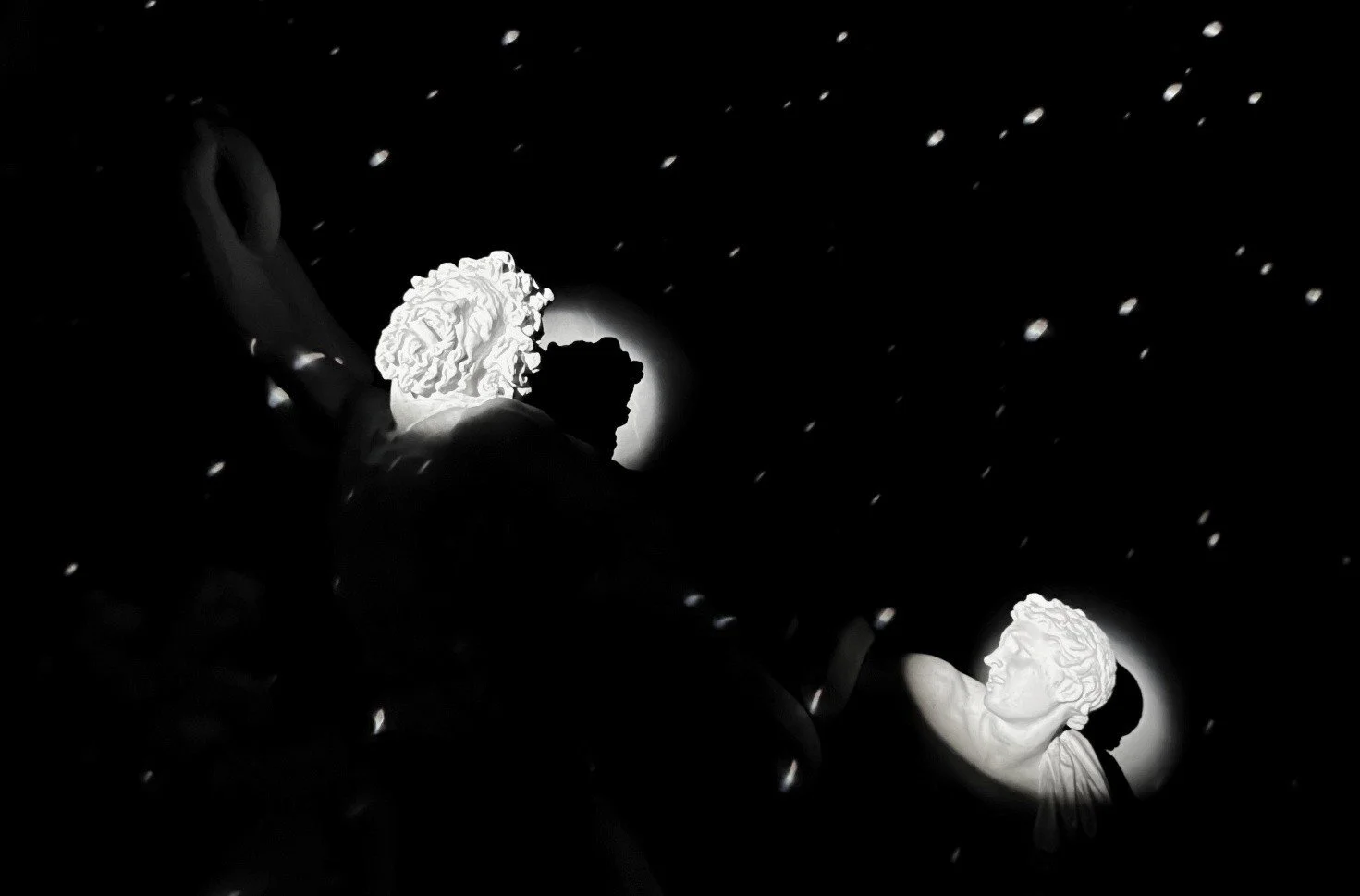
A detail from Transiti (photo: Gatd)
The same delicate and discreet approach informed the technical decisions as well. In order to preserve the identity of the site and avoid overwhelming it with intrusive equipment, Crisafulli chose to construct the installation using simple, artisanal means. Four overhead projectors, together with a profile spotlight illuminating the performance area, were the only technical devices employed. With them he created a nocturnal, dreamlike vision that gradually emerged from the space itself, from its objects, and from the interplay between light, movement and sound.
The acoustic dimension was identified from the outset as one of the performance’s structural elements. When moved or handled, the wooden chairs creak. This noise, generated by the environment itself, was sampled and became the primary material for the sound composition created for the occasion by Andreino Salvadori, Crisafulli’s long-standing collaborator. Salvadori combined it with other sounds associated with the site and its context. A murmur of voices, through a subtle interplay of meanings, evoked the presence of students during class hours while also suggesting the whispers of the audience. The tinkling of crystal recalled the presence of the chandelier. Distant rumbles echoed the blasts from the Apuan quarries, which, notably, are visible from the windows of the hall itself. At intervals, moments of silence brought to the fore the creaking produced live by Lohman’s actions among the chairs, establishing a continuous exchange between actual and reproduced sounds.
Inseparable from the performance, the soundscape also served as a source of inspiration for the light installation. In particular, the impression produced by the creaking sounds, which Crisafulli likened to ‘points’ of noise, found a visual counterpart in the ‘points’ of light from which the image of the firmament emerged. This image was constructed through a process of successive layering. First, the faces of seven statues positioned along the walls were isolated and individually illuminated by beams of light, causing them to emerge from the darkness like celestial bodies. From this initial configuration, the idea of a star-studded cosmos began to take shape. The stars were produced by piercing tiny holes in the gobos used to filter the light. Finally, these points of light were progressively concentrated towards the centre, until the individual elements coalesced into a unified vision converging upon the chandelier.
At the same time, the performance itself gradually took shape, acquiring new associations and resonances with each transformation of the space. At first the chairs were perceived as mere furnishings. Then, through their forms, their solidity and their characteristic sounds, Melissa Lohman’s actions began to transfigure them into the sea, but also into a ship or a forest. At a further level of elaboration, the performer herself became an integral part of a world in which the reality of the site appeared inverted, amplified and transposed into a timeless dimension that expanded both its perception and its presence. The body in movement, at once instrument and material of the creation, thus became, through a network of subtle yet compelling correspondences, the centre of gravity of a quasi-Ptolemaic universe: a planet Earth traversed by the gazes of other planets.