
performance art

Building a Place. Inhabiting it: Fabrizio Crisafulli and Melissa Lohman

Building a Place. Inhabiting it: Fabrizio Crisafulli and Melissa Lohman

Edited by Mara Nerbano, Professor of the History of the Performing Arts at the Academy of Fine Arts of Carrara, the following section examines the collaboration between theatre director and visual artist Fabrizio Crisafulli and performer Melissa Lohman. It comprises an introduction by the editor, her essay on Transiti, an installation-performance created by the two artists in Carrara in 2023, and an interview with them exploring the principles and working methods underpinning the piece. The section also includes two texts, one by Crisafulli and one by Lohman, analysing Tramite, the work they created in 2024 in the burial chamber of the Pyramid of Cestius in Rome, and comparing its approach with that of the Carrara project.
Taken together, these texts offer an in-depth analysis of the two artists’ creative partnership and provide new insights into contemporary performance, particularly into the ways in which place, light and action shape and inform one another.

The Conceptual Framework of Corpoluce

The Conceptual Framework of Corpoluce

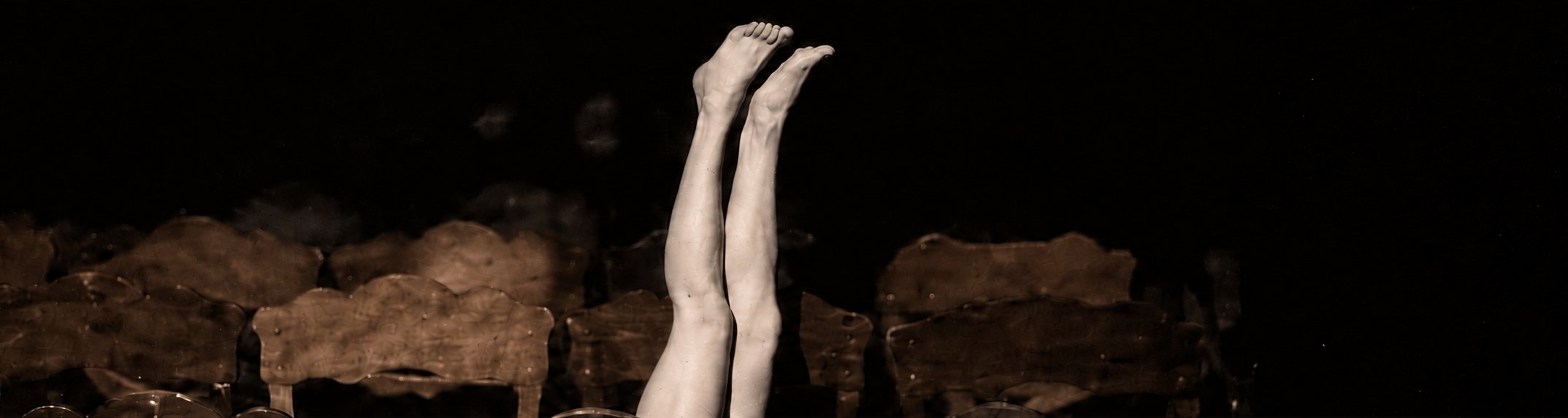
This previously unpublished text by Italian director and visual artist Fabrizio Crisafulli concerns Corpoluce, a performance created in 2018 in collaboration with dancer Alessandra Cristiani. The text retraces the genesis of the work and examines its conceptual and operational implications within the broader context of Crisafulli’s research on theatrical light (see F. Crisafulli, Active Light: Issue of Light in Contemporary Theatre (2015), and N. Tomasevic (ed.), Place, Body, Light: The Theatre of Fabrizio Crisafulli (2022), both published by Artdigiland).
Corpoluce emerges from a critical reflection on prevailing notions of theatrical light, which often privilege lighting instruments over sustained exploration of the relationships that light can establish with body and space. The performance demonstrates how complex and articulate results can be achieved with minimal means, when the relational potential of light is investigated in depth.

Il dispositivo concettuale di Corpoluce

Il dispositivo concettuale di Corpoluce

Testo inedito del regista e artista visivo italiano Fabrizio Crisafulli che riguarda Corpoluce, una performance da lui creata nel 2018 in collaborazione con la danzatrice Alessandra Cristiani. Il saggio ripercorre la genesi di questo lavoro e ne esamina le implicazioni concettuali e operative, inquadrandole nel contesto della più ampia ricerca di Crisafulli sulla luce teatrale (vedi i volumi F. Crisafulli, Luce attiva, Questioni della luce nel teatro contemporaneo, Titivillus, Corazzano (PI), terza edizione 2024e N. Tomasevic (a cura di), Place, Body, Light: The Theatre of Fabrizio Crisafulli, Artdigiland, Dublino, seconda edizione 2022).
Corpoluce nasce da una riflessione sulle comuni pratiche della luce teatrale, spesso più attente agli strumenti di illuminazione in sé che alla cura delle relazioni che la luce può instaurare nello spazio. La performance costituisce un esempio di come risultati molto complessi possono essere ottenuti anche con mezzi molto limitati, quando le possibili relazioni della luce con gli altri elementi (in questo caso, con il corpo) vengono attentamente studiate e messe a frutto.